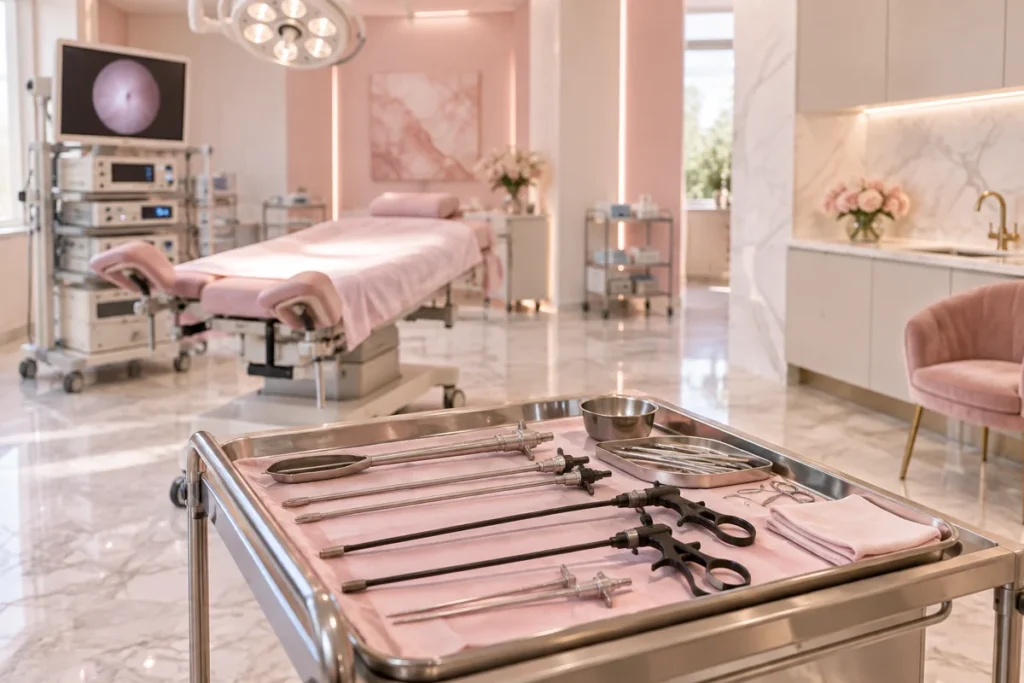
The laparoscopy cost in private practice is rarely a single number, because the final price depends on the type of procedure performed, the hospital used, the anaesthetic required and whether any additional treatment is carried out at the same time. In short, the laparoscopy cost is the combined total of the consultation, the surgeon’s fee, the anaesthetist’s fee and the hospital theatre charge, and it rises with the length and complexity of the operation. Most private laparoscopy quotations in London are built from several separate components, including the initial consultation, the surgeon’s fee, the anaesthetist’s fee, the hospital or theatre charge and any laboratory tests. Understanding how those parts fit together makes it far easier to compare quotations fairly and to avoid unexpected charges. This guide, prepared with insight from Consultant Gynaecologist and Gynaecological Oncology Surgeon Mr Saurabh Phadnis, explains what patients in London are typically paying for and why. It was updated in 2026 to reflect how London hospitals currently present their quotations.
Mr Saurabh Phadnis (MBBS, MRCOG) is a Consultant Gynaecologist and subspecialist gynaecological oncology surgeon practising in London, with particular expertise in minimally invasive and complex abdominal surgery, colposcopy and the management of gynaecological cancers. He works across both NHS and private settings, which means patients receive advice grounded in everyday surgical practice rather than in sales targets. The information below is educational and general; a personalised written quotation should always be obtained before any procedure is booked.
Laparoscopy, sometimes called keyhole surgery, allows a surgeon to examine and often treat the pelvic organs through small incisions using a camera and fine instruments. According to the NHS, laparoscopic surgery generally involves less post-operative pain, a shorter hospital stay and a faster return to normal activity than open surgery. The NHS also notes that the incisions used are usually only 0.5 to 1.5 cm long, which is one reason recovery tends to be quicker. Those advantages are one reason many women choose the keyhole approach when it is clinically appropriate.
In the private sector, the quoted laparoscopy cost usually falls into one of two formats: an itemised set of fees, or a fixed-price package that bundles most elements together. Fixed-price packages are increasingly common in London hospitals and can offer reassurance, but they often exclude the initial consultation and any pre-operative imaging, so it is worth reading the exclusions carefully.
A typical private quotation is made up of the following elements:
Because these components are priced independently, two quotations for apparently the same operation can differ significantly. Asking for the breakdown in writing is the single most useful step a patient can take.
The single biggest driver of price is complexity. A short diagnostic laparoscopy to investigate pelvic pain occupies far less theatre time than a laparoscopic procedure to remove extensive endometriosis or a large ovarian cyst. Theatre time, staffing and the instruments used all scale with complexity, and so does the fee.
Broadly, procedures sit on a spectrum:
Conditions such as fibroids illustrate the point well: the number, size and position of the fibroids can change an operation from a routine day case into a lengthy procedure, and the quotation will reflect that. Endometriosis is another example, affecting around 1 in 10 women of reproductive age, and the extent of disease found at surgery is one of the main reasons two quotations for keyhole surgery can differ. The Royal College of Obstetricians and Gynaecologists publishes patient information on gynaecological procedures that can help women understand what a particular operation involves.
Yes. Central London hospitals typically charge more than facilities further out, reflecting overheads and facilities. The type of anaesthetic, the duration of theatre time and whether a bed is needed overnight all feed into the total. Patients with other medical conditions may require additional pre-operative assessment or a higher level of post-operative monitoring, which can also affect the final figure.
On the NHS there is no charge to the patient for laparoscopic surgery. The main differences in the private sector are choice of consultant, choice of timing and continuity of care, with the same named surgeon carrying out the consultation, the operation and the follow-up. Waiting times are usually shorter, which some women find valuable when symptoms are affecting work, fertility plans or daily life.
It is important to be clear that private care does not mean different clinical standards. All surgeons operating privately in the UK must hold full General Medical Council registration, and clinical decision-making should follow the same evidence base, including NICE guidance, whichever setting is used. Patients who want to see how private and NHS pricing compare for another common gynaecological service may find the guide on NHS versus private colposcopy costs in the UK a useful illustration of the same principles.
Many private medical insurance policies cover diagnostic and therapeutic laparoscopy, provided the referral pathway is followed correctly. In most cases this means obtaining a GP referral letter, contacting the insurer for pre-authorisation and confirming the procedure codes with the consultant’s secretary before booking. Insurers may apply an excess, exclude pre-existing conditions or limit outpatient benefit, so checking the policy wording in advance avoids disappointment.
Self-funding patients usually receive a fixed-price quotation, which can be reassuring because it caps the laparoscopy cost for standard care. Fixed prices normally assume an uncomplicated recovery; if an unexpected complication requires extended care, additional charges may apply, and reputable hospitals will explain this clearly.
Cost matters, but it should not be the only factor. Surgical experience with the specific condition, the volume of similar procedures performed, and access to a full multidisciplinary team all influence outcomes, particularly for complex endometriosis, large fibroids and suspected malignancy. Patients can review the range of gynaecological treatments offered in London to understand which pathway may apply to their symptoms.
Recovery should also be factored into planning. Most women return to light activity within a week or two after a straightforward diagnostic laparoscopy, while more extensive surgery may require four to six weeks away from demanding work. Time off, travel and childcare are real costs that quotations do not include.
There is no single figure. The laparoscopy cost depends on whether the procedure is diagnostic or operative, the hospital used, theatre time and whether an overnight stay is needed. Diagnostic day-case surgery sits at the lower end, complex operative laparoscopy at the higher end. Always request a written, itemised quotation.
Sometimes. Fixed-price packages usually include the anaesthetist’s fee, whereas itemised quotations often list it separately. Because laparoscopy is performed under general anaesthetic, this fee always applies, so it is worth confirming explicitly before booking.
Many policies do, subject to pre-authorisation, policy limits and any excess. Pre-existing condition exclusions are common. Contact your insurer with the proposed procedure codes before your surgery date, and ask the consultant’s secretary to confirm whether they are recognised by your provider.
Not necessarily, but compare like with like. A lower price may simply reflect a shorter, simpler procedure or a hospital with lower overheads. Check what is excluded, particularly pathology, follow-up appointments and cover for complications, before assuming one quotation is better value.
Recovery varies with the procedure. After a diagnostic laparoscopy, many women feel much better within a week, though shoulder tip discomfort and fatigue are common initially. More extensive surgery may need several weeks. Your surgeon will give individual guidance based on the findings.
Often, yes. Conditions such as endometriosis, adhesions or an ovarian cyst can frequently be treated during the same operation, which is discussed and consented for beforehand. This may affect the final laparoscopy cost, so ask how combined procedures are priced.
Choosing keyhole surgery privately is as much about clarity as about price: a transparent, itemised quotation, a clear explanation of what the operation involves and realistic expectations for recovery all matter. If you would like to understand which procedure may be appropriate for your symptoms and what the laparoscopy cost would be in your case, you can explore the conditions treated and arrange a consultation with Mr Saurabh Phadnis in London for an individual assessment and a written estimate.